From Fan Magazine to Screen Feed: A Short History of Celebrity Access
Celebrity access has shifted from edited fan-magazine profiles to direct screen feeds; see what each format reveals, withholds and asks audiences to trust.
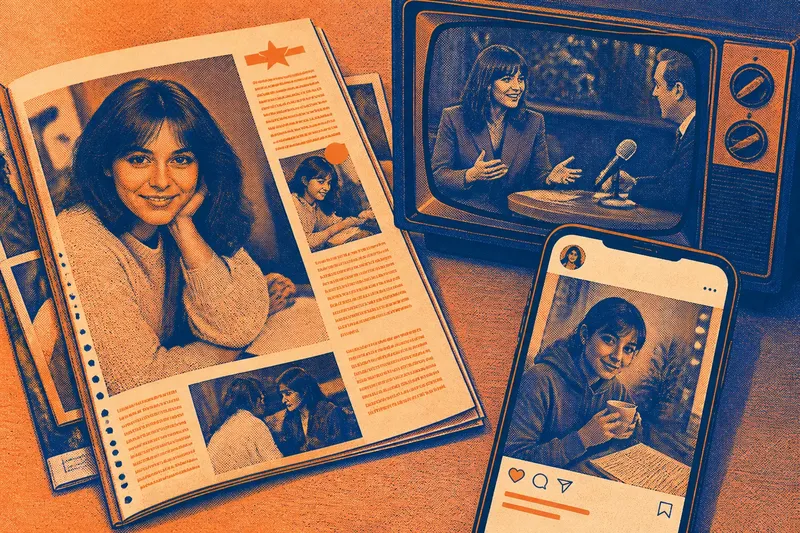
Celebrity access has never meant unrestricted access. A fan magazine profile and a performer’s screen feed both bring a star closer, but each offers a different kind of closeness, shaped by its format and purpose. Following that change helps explain why audiences may feel they know a performer while still seeing only a carefully bounded view.
What did a fan magazine let readers see?
Fan magazines made performers feel present through profiles, photographs, interviews and recurring personal details. Readers might learn about a favourite actor’s preferred clothes, family life, ambitions or daily habits. The material appeared intimate, but it had been selected, arranged and edited before reaching the page.
That selection was not necessarily a trick. Editors worked within the conventions of a publication, and studios or publicity offices could help arrange interviews and photographs. A profile might foreground charm, hard work or domestic warmth because those qualities fit the performer’s public image and the magazine’s readership. Other subjects could remain outside the story.
The reader’s relationship with the star was also shaped by distance. A printed issue arrived as a finished object: the interview had been conducted, the pictures chosen and the pages closed. Readers could revisit it, save it or discuss it, but they could not ask the performer a question in the margin and expect a reply. Access meant receiving a prepared account, not entering an ongoing conversation.
Why did celebrity access feel more personal?
Personal detail creates a sense of recognition. A reader who follows a performer’s favourite recipes or backstage routines may feel familiar with them, even if those details reveal little about the person’s private life. The same effect can come from recurring visual cues: a familiar room, a pet, a casual outfit or a glimpse of work in progress.
There is a useful distinction between access to a person and access to a public persona. A fan magazine could disclose ordinary details while still organising them into a story that suited the performer’s image. Later formats changed who could publish and how quickly, but they did not make the boundary disappear. The closer the communication seems, the more useful it is to ask what kind of information is actually being shared.
Imagine a reader sees a profile in which an actor talks about practising lines over breakfast. The detail may make the actor’s working life feel accessible; it does not reveal how the interview was prepared, what questions were set aside or what the rest of the morning looked like. The sensible reading is neither to dismiss the profile nor to treat it as a complete portrait.
What changed when celebrity media moved on screen?
Radio and television added voice, timing and performance to the experience of celebrity. An audience could hear a performer speak or watch them respond, rather than relying only on an editor’s written description. This made presence more vivid, but broadcasts still depended on a programme, a host, a schedule and editorial choices.
A guest appearance was a particular kind of access: the performer entered a show whose format set the boundaries. A host might ask personal questions, invite a comic exchange or steer the conversation towards a current role. The audience saw spontaneous gestures and pauses, yet the encounter remained a produced segment. A live feeling is not the same as an unmediated one.
Later, websites and social platforms let performers and their representatives publish material without waiting for a magazine profile or broadcast slot. A short post could appear quickly, speak in a first-person voice and reach an audience directly. The change was substantial: performers could address followers between formal publicity appearances, while audiences could react in public. But direct publication still involved choices about what to show, when to post and which replies to notice.
What does a screen feed reveal and conceal?
A screen feed is not simply a smaller magazine. It is an ongoing stream, where a polished announcement might sit beside a brief backstage clip, a promotional image or a personal note. The mixture can make access feel informal because different kinds of material appear close together. That arrangement can also blur the line between conversation, performance and publicity.
Direct-to-audience channels give performers more control over their own wording and timing. They can correct a misunderstanding, share an update or speak to followers without an interviewer shaping the exchange. Yet control over publication does not mean every part of a performer’s life is available, nor does it remove the work of public relations. A post can be personal in tone and promotional in purpose at the same time.
The audience’s role has changed, too. Readers once encountered a profile as a completed piece; followers can now respond, circulate a clip or ask a question. That participation may create a sense of dialogue, although a performer cannot personally answer every response. The visible exchange is only one part of a much larger stream, with attention, moderation and platform design affecting what people see.
How can readers judge the kind of access they are getting?
A helpful approach is to treat each format like a different window. A window offers a view from one position; it does not show the whole building. Look at the material’s setting and purpose before deciding how much it tells you.
- Notice who published it. A magazine, programme, official account and fan-run page have different roles and responsibilities.
- Look for the occasion. A profile tied to a new release may place special emphasis on the work being promoted.
- Separate observation from interpretation. A clip may show a performer laughing; claims about what the laugh means are an additional reading.
- Check whether the exchange is open or curated. A question-and-answer session, a comment thread and a one-way announcement offer different forms of participation.
- Keep the missing context in view. A short post cannot show every conversation, decision or moment around it.
These checks are not a demand to distrust every public appearance. They help readers distinguish what a format makes visible from what they infer. A warm anecdote can be enjoyable on its own terms without being treated as evidence that the audience knows the performer personally.
What do readers ask about celebrity access?
Are fan magazine profiles reliable?
They can offer useful material about how a performer was presented and what the publication considered appealing to its readers. Treat personal claims as part of an edited account, and look for context before treating them as a complete record.
Is a social media post more authentic than an interview?
Not automatically. A performer may have more control over a post, while an interview may include follow-up questions, but both are shaped by audience, purpose and selection.
What does direct-to-audience mean?
It means a performer or their team can publish to followers without relying on a conventional magazine or broadcaster as the immediate outlet. The message can still be planned, edited or connected to publicity.
Why do audiences feel close to celebrities?
Repeated contact, familiar details and first-person communication can create recognition and a sense of conversation. Those feelings are real responses, but they do not mean the relationship is reciprocal in the same way as a personal friendship.
What has changed, and what has stayed the same?
The route to an audience has widened. A performer can appear in a magazine, on a broadcast and in a direct screen feed, each with its own pace and conventions. Audiences can answer back more visibly than print readers could, while performers and their teams can publish without waiting for an editor to offer space.
What has stayed familiar is the work of shaping a public image. Every format selects details, creates a point of view and leaves other things unseen. The shift from fan magazine to screen feed is therefore not a simple journey from distance to truth. It is a change in who can speak, how quickly the audience can respond and what kind of closeness a medium invites. Celebrity access makes most sense when readers enjoy the view while remembering where the frame begins.